

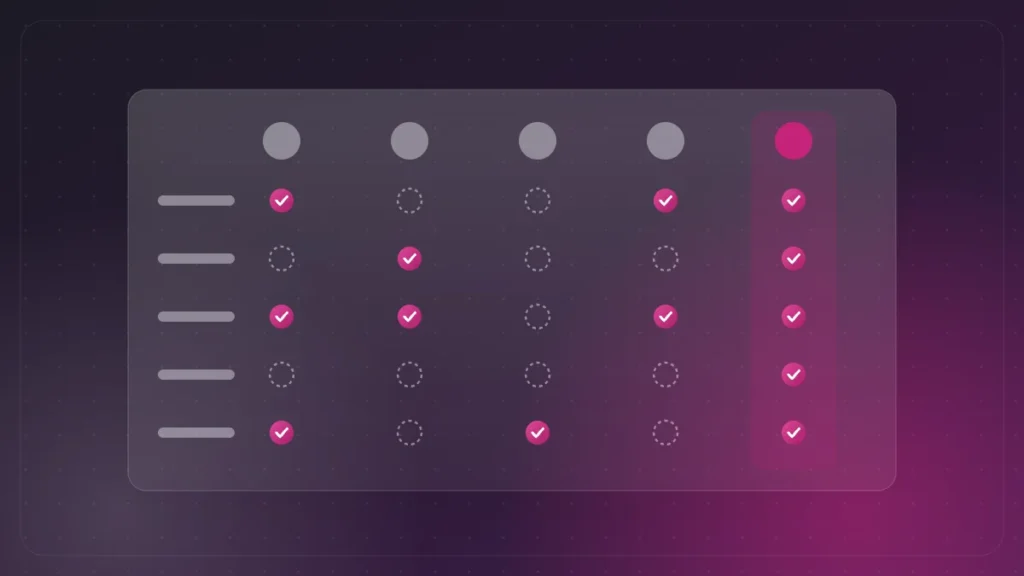
Most competitor analyses end as a slide of logos and a vague conclusion: “they are active on social media.” That is not analysis; it is a list. A useful competitor analysis answers one practical question: where can we win that others are leaving open? It should end with decisions about your offer, message, channels and priorities.
This six-step method uses free tools and can be completed in a few working days. It is designed for business owners and marketing managers who need clear direction, not a research report nobody reads.
Step 1: Choose the right competitors
Your competitors are not only the businesses you see at exhibitions. Build three short lists:
- Direct competitors: same service, same customers, same city or market. Pick three to five.
- Search competitors: whoever appears on the first page when your customers search your main terms. These can be directories, marketplaces or content sites, and they compete for the same attention even if they sell nothing similar.
- Alternatives: what customers do instead of buying from anyone in your category, such as doing it in-house, buying cheaper, or postponing.
Ask your sales team which names come up in lost deals. That list is often more accurate than your assumptions.
Step 2: Audit the offer, not just the marketing
Customers compare offers before they compare ads. For each direct competitor, record:
- The main promise on their homepage and service pages.
- Pricing or pricing signals: published prices, ranges, “starting from”, or none.
- Guarantees, delivery times, packages and payment options.
- Proof: portfolio, case studies, number and quality of reviews.
- Friction: how hard it is to get a quote or speak to someone. Try it yourself.
A “mystery shopper” enquiry through each competitor’s website and WhatsApp is one of the most revealing exercises you can do. Note response time, tone and how quickly they ask about budget.
Step 3: Map search visibility
Search your ten most important terms in Arabic and English, on mobile, from your target city. For each term note who ranks in the map results, the organic results and the ads. Patterns appear quickly: a competitor that dominates local map results, a directory that owns the informational queries, a gap where nobody has a strong page.
Two free checks help: the site: search operator gives a rough sense of how many pages a competitor has indexed and which topics they cover, and reading their top-ranking pages shows the depth you would need to beat. Arabic searches deserve their own attention because spelling variants change the results; our guide to Arabic keyword research explains how.
Step 4: Review their advertising
Platforms now publish ads openly. The Google Ads Transparency Center shows ads run by verified advertisers on Google, and the Meta Ad Library shows active ads across Facebook and Instagram. Look for:
- Which offers they repeat over months. Long-running ads are usually profitable ones.
- Which formats they favour: video, carousel, lead forms, WhatsApp click-to-chat.
- Seasonal patterns around Ramadan, Eid, White Friday or National Day.
Do not copy creative. You are looking for the questions their ads answer, and the ones they leave unanswered.
Step 5: Assess content, social and reputation
For each competitor, look at the last three months of social posts and the last ten reviews on Google Maps. Note:
- Posting consistency and which content types earn comments, not just likes.
- Whether they publish educational content or only promotions.
- Recurring complaints in reviews. These are opportunities: if customers regularly complain about late delivery, reliability becomes a message you can own if you can deliver it.
- How they respond to negative reviews, which signals how they treat customers.
Step 6: Turn findings into a gap matrix and decisions
Put the findings in one table, then mark where each competitor is strong, weak or absent.
| Dimension | Competitor A | Competitor B | Competitor C | Us | Opportunity |
|---|---|---|---|---|---|
| Clear pricing | Yes | No | No | No | Publish ranges |
| Response time to enquiry | Same day | 2 days | Hours | Next day | Commit to 1 hour |
| Arabic service pages | Thin | Strong | None | Thin | Build in-depth pages |
| Map pack visibility | Strong | Weak | Weak | Weak | Local SEO and reviews |
| Educational content | None | Some | None | None | Guide-led content |
The table above is a hypothetical example. From your own version, choose two or three decisions only, for example: “publish price ranges on the three main service pages,” “commit to a one-hour response,” “build an Arabic guide for the question every competitor ignores.” Those decisions feed straight into your 90-day marketing plan.
Mistakes that make competitor analysis useless
- Copying the leader: matching a bigger competitor’s message makes you a smaller version of them.
- Counting followers: audience size says little about whether it buys.
- Doing it once: markets move. Repeat a light version every quarter and a full one each year.
- No decision at the end: if the analysis does not change what you do next month, it was not needed.
Next step
Pick your three direct competitors and spend one hour on Step 2 this week, including a mystery-shopper enquiry. You will learn more about your positioning from that hour than from most reports. If you would like a structured market and competitor review as the foundation of a written plan, it is the first stage of our marketing strategy and growth planning service. Request a proposal and tell us who you compete with.
Ready to start? Tell us about your business
We review your request and reply with a clear plan and a quote.
Request a Quote